 About Us
  About Us
 Overview
2024-02-041. History
The Chinese Traditional Culture Museum (CTCM), established in 1990, was initially under the administration of the Ministry of Light Industry and later the State-owned Assets Supervision and Administration Commission of the State Council. In 2006, it was transferred to the former Ministry of Culture. In January 2022, the museum gained approval for the additional name "China Intangible Cultural Heritage Museum".
The museum gained its establishment approval by the State Council and its endorsement by the National Development and Reform Commission in 2011. The museum's location was finalized in 2013, which was followed by the groundbreaking ceremony on March 30, 2019. The main structure was topped out on July 31, 2020, and the completion acceptance process concluded on January 5, 2022.
On Feb 5, 2022, the museum officially opened to the public. The inaugural exhibition, titled "Treasures of China: Exhibition of Intangible Cultural Heritage and Arts and Crafts", garnered widespread acclaim and an enthusiastic response.
2. Overview
The CTCM is a non-profit public institution under the Ministry of Culture and Tourism. It is dedicated to the preservation and exhibition of exemplary Chinese arts and crafts, spotlighting key projects representing China’s intangible cultural heritage.
The museum’s mission is to inherit and promote outstanding traditional Chinese cultures, carry out research on Chinese arts and crafts and intangible cultural heritage, engage in digital protection and display, collect and appraise representative arts and crafts of China, organize relevant exhibitions and performances, foster domestic and international exchanges and collaborations, develop cultural and creative products, and engage in related social services and education and training.
The museum consists of an Administration Office, Party Committee Office (Discipline Inspection Commission Office), Human Resources Department, Finance Department, Collection and Acquisition Department, Exhibition Department, Social Service Department, Academic Research Department, Digital Information Department, and Logistics and Security Department.
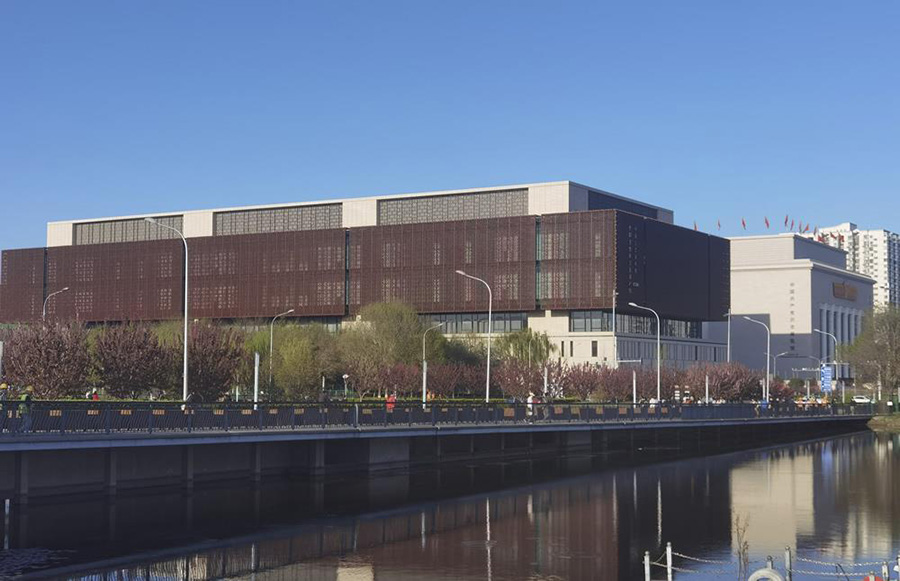
Shown here is a view from the southwest side of the Chinese Traditional Culture Museum.
3. Information on exhibition hall
The museum is situated at 16 Hujing East Road, along the north extension of Beijing's central axis. It faces the dragon-shaped water system of the Olympic Forest Park to the west and connects to the Museum of the Communist Party of China to the east. The museum is surrounded by the Bird's Nest and the Water Cube to the south, and is adjacent to the China Science and Technology Museum to the north.
The museum has a total floor area of 91,126 square meters, with a length of 201 m from north to south, a width of 75 m and a height of 50 m. It consists of six above-ground floors and two underground floors, and houses fourteen exhibition halls and one multi-functional hall.
The architectural design of the museum exhibits a symmetrical structure both vertically and horizontally. The facade is divided into three sections: a stone layer at the bottom, a transparent platform layer in the middle, and a pavilion at the top, symbolizing the harmonious balance of heaven, earth and humanity in traditional Chinese culture. The exterior features a brown-copper metal grid structure inspired by traditional architectural window patterns and antique shelves, integrating traditional design elements with modern architectural frameworks and presenting an overall dignified yet lively aesthetic.

The corner of the exhibition hall with light and shadow in the background.
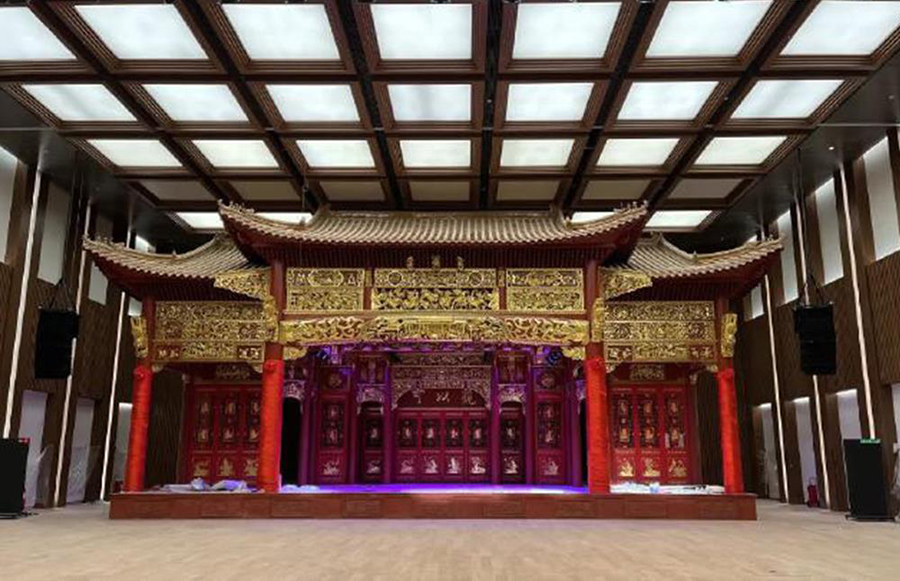
The CTCM multi-functional hall
4. Collection overview
The museum currently collects a wide range of artworks and handicrafts. The main focus is on works created after the founding of the People's Republic of China. Among them, four large-sized jade artworks — "Magnificent Scenery of Mount Tai (Daiyue Qiguan)", "Condensing fragrance and auspiciousness (Hanxiang Jurui)", "Diverse Blooms (Qunfang Lansheng)", and "Joyful Celebration Across the Seas (Sihai Tenghuan)" — are considered national treasures due to their large scale, excellent materials, ingenious design and exquisite craftsmanship.

Miniature Jadeite Hill - A Magnificent View of Mountain Taishan (Daiyue Qiguan)
Dimensions: 88cm × 60cm × 102cm

Jadeite Incense Burner - A Fragrent and Auspicious Gathering (Hanxiang Jurui)
Dimensions: 65cm×47.5cm×96cm

Jadeite Floral Basket - Myriad Flowers in Full Bloom (Qunfang Lansheng)
Dimensions: 42.3cm×30cm×97cm

The Four Seas Rejoice (Sihai Tenghuan), a jade screen carved with surging sea pattern
Dimensions: 177.5cm×34.7cm×112cm